





| About this Journal | Browse Archive | For Authors |
Korean Journal of Health Education and Promotion
보건교육건강증진학회지
- KCI(Korea Citation Index)
- DOI(CrossRef)
- DOI(CrossCheck)
ISSN : 1229-7631 (Print) / 2635-5302 (Online)
KJHEP
- KCI(Korea Citation Index)
- DOI(CrossRef)
- DOI(CrossCheck)
Korean Journal of Health Education and Promotion
ISSN : 1229-7631 (Print) / 2635-5302 (Online)
Sorry.
You are not permitted to access the full text of articles.
If you have any questions about permissions,
please contact the Society.
죄송합니다.
회원님은 논문 이용 권한이 없습니다.
권한 관련 문의는 학회로 부탁 드립니다.
Instructions for Authors
The author who wants to submit a manuscript to the Korean Journal for Health Education and Promotion (KJHEP) should follow the instructions below.
Aims and scope
The Korean Journal of Health Education and Promotion is the official peer-reviewed, open-access journal for the Korean Society for Health Education and Promotion. The Journal aims to contribute to the advancement of health education and promotion theory and research and to represent emerging research trends and current affairs in practice and policy. The journal contains original (research) articles, review articles, opinion papers, case studies, news in briefs and book reviews.
The former English titles of the journal include “The Journal of Korea Society for Health Education (1987-1988)”, “The Journal of Korean Society for Health Education (1988-1998)”, “Journal of Korean Society for Health Education and Promotion (1999-2009)”, and “Korean Journal of Health Education and Promotion (2009-current)”
The Korean Journal of Health Education and Promotion is published 5 times a year on March 31, June 30, September 30, October 1, and December 31. Its official abbreviated title is ‘Korean J Health Educ Promot’.
Journal publication and manuscript submission
The journal is published five times annually: four regular issues on March 31, June 30, September 30, and December 31, and one special themed issue within the same calendar period. All issues are bilingual, published in both Korean and English. Manuscripts are accepted year-round; however, to be considered for a specific issue, submissions must be received at least two months prior to its publication date (i.e., by January 31, April 30, July 31, or October 31).
Research and publication ethics
1. Research ethics committee
The Society establishes and operates a Research Ethics Committee to uphold research integrity and verify ethical standards.
- ① The committee consists of 5-7 members, including the editor-in-chief, who serves as a chair.
- ② Other members shall be appointed by the chair from among the editorial board, considering their relevant expertise.
- ③ The chair can appoint external experts if needed, following consulting the committee.
Authors must make every effort to avoid research misconduct such as fabrication, falsification, plagiarism, or inappropriate attribution of authorship. Types of misconduct include:
- ∙ Fabrication: Making up data or research results that do not exist.
- ∙ Falsification: Manipulating research materials, processes, or data to distort research findings.
- ∙ Plagiarism: Using others’ ideas, research, or results without proper approval or citation.
- ∙ Inappropriate attribution of authorship: Granting authorship without significant contribution or excluding qualified contributors, or rewarding non-contributors for non-academic reasons.
- ∙ Obstruction or retaliation against investigations of misconduct.
- ∙ Other actions seriously deviating from accepted academic standards.
- ∙ Proposing, forcing, or threatening others to commit misconduct.
If misconduct is discovered after publication, appropriate corrective actions and disciplinary measures will be implemented.
If any ethics violations occur, the Editorial Board will refer the case to the Research Ethics Committee for further investigation and action. The Committee will conduct review violations according to the procedures, and if misconduct is confirmed, appropriate sanctions shall be applied in accordance with established regulations.
2. Institutional review board approval
In studies of human subjects, the procedures should be in accordance with the ethical standards of the Institutional Review Board (IRB) of authors’ institute and with the Helsinki Declaration in 1975 (revised in 2000). For the policies on the research and publication ethics not stated in this instruction, “Good Publication Practice Guidelines for Medical Journals (http://kamje.or.kr/publishing_ethics.html)” or “Guidelines on Good Publication (http://www.publicationethics.org.uk/guidelines)” can be applied.
3. Conflicts of interest
Conflict of interest exists when an author or the author’s institution, reviewer, or editor has financial or personal relationships that inappropriately influence the work. The conflict of interest may occur during research process; however, important point is the disclosure itself. If there is a disclosure, editors, reviewers, and reader can approach the manuscripts after understanding the situation where the research work was processed. Any conflicts of interest related to the submitted work must be disclosed. If there is a disclosure, editors, reviewers, and reader can approach the manuscripts after understanding the situation where the research work was processed. Any conflicts of interest related to the submitted work must be disclosed.
4. Originality, plagiarism, and duplicate publications
It is postulated that all submitted materials are original and not being considered by other scientific journals. Plagiarism and duplicate publication is checked through Cross-Check and eTBLAST upon submission. Authors who are found to have engaged in plagiarism or duplicate publication can not submit a paper to this journal for three years. Secondary publication may be considered if the editors of both journals approve. Any findings of misconduct or duplicate publication prior to or during the review process will result in a prohibition from submitting new manuscripts for a minimum of three years.
Manuscript types
The Korean Journal of Health Education and Promotion publishes the following types of manuscripts.
- Original (research) article :
- an original research article in the broad field of health education and promotion including experimentation, surveys, evaluations and research on planning, policies and systems.
- Review article :
- a review on the current trends on specific themes in the field of health education and promotion.
- Opinion paper :
- a discussion on current challenges and solutions of specific topics in health education and promotion.
- Case report :
- a report on successful or unsuccessful cases of health education and promotion programs.
- Short communication :
- news articles on introducing current developments in the field of health education and promotion.
Manuscript preparation
Manuscripts submitted to the Korean Journal of Health Education and Promotion should be in proper and clear Korean or English. Submissions must include four separate files: 1) Title Page, Main Text, Author Checklist, and Similarity Check Report. Manuscripts should be formatted on A4-sized paper, using 10-point font, with double spacing (200%). The documents should be prepared using the extension .doc/.docx for MS Word program or .hwp/.hwpx for Hancom HWP program. Page numbers should be sequential starting from the title page.
Manuscripts submitted to the Korean Journal of Health Education and Promotion should be in proper and clear Korean or English. Manuscripts should be written and numbered in the following sequence: title page, main text, references, abstract, key words, tables, and figures.
1. Title page
The title page must clearly indicate “Manuscript Submission to the Journal of the Korean Society for Health Education and Promotion” and include the following in both Korean and English: manuscript title, author names, affiliations, academic degrees, ORCID, and contact information of the corresponding author (including phone number, fax number, and e-mail address). Funding sources and acknowledgments should be clearly disclosed if applicable.
- ① If there are two or more authors, separate each author’s name with commas(,). Different affiliations must be marked with superscripts (e.g., *, **), and the corresponding author denoted with †.
- ② All authors should generally have a single affiliation; if multiple affiliations are necessary, prior approval from the editorial board must be obtained.
- ③ Author names in English should follow the order ‘Given Name Surname’, with each syllable separated by a space and the first letter capitalized. Hyphenated names and unique identifiers are to be retained as originally formatted.
- ④ The manuscript title should be concise accurately summarizing the study, avoiding phrases like “A Study of...” or “A Review of...”. Abbreviations should generally not be used.
- ⑤ ORCID IDs must be provided for all authors (available at http://orcid.org/).
2. Main text (Original articles)
- ① The main text should be structured as follows: Title, Introduction, Methods, Results, Discussion, Conclusion, References, Abstract, Key Words, and Tables/Figures.
- ② The Methods section should include the study design, theoretical basis for variable selection, and ethical approval status.
- ③ The Discussion section should contextualize findings with existing literature, highlight originality and additional contributions of the study, and discuss practical implications for the field of health education and promotion.
- ④ The Conclusion section should synthesize the findings rather than merely restating results.
- ⑤ The Abstract should be written in English, limited to 200 words in English, and include key words (3-5 words). It should follow the structure: Objectives, Methods, Results, and Conclusion, without abbreviations.
- ⑥ When reporting gender, clearly distinguish between biological sex and gender, and compare results when both are included. Studies with a single gender should provide scientifically justified rationale.
3. Main text (Other than original articles)
- ① Follow the same formatting as original articles.
- ② Manuscript types include:
- ∙ Review article : Title, Introduction, Main Text, Conclusion, References, Abstract, Tables/ Figures.
- ∙ Opinion paper : Title, Text, References, Abstract, without a fixed format unless necessary.
- ∙ Case report : Title, Introduction, Case, Discussion, Conclusion, References, Abstract, Tables/ Figures.
- ∙ Short communication : Follows the format of original articles, but allows flexibility in structure.
- ③ The abstract should summarize objectives, methods, results, and conclusions within 150 words without subheadings.
4. Notation and style
- ① Section headings must follow the hierarchy: I, 1, 1), (1).
- ② Proper nouns, numbers, and measurements should be formatted as follows: personal names and geographical locations in native language; Arabic numerals for numbers; metric units for measurements.
- ③ Citation and paraphrasing of other literature should be consistent as follows:
- ∙ Quotation: When directly including words or sentences from other researchers, enclose the quoted text in quotation marks and cite the source appropriately. For example: “Behavior is determined by multiple factors” (Choi, 2007: 18).
- ∙ Paraphrasing: When restating literature for clarity without direct quotation, cite by author’s surname and publication year within parentheses. For example: (Kim, 2010).
- * If two or more references published in the same year by authors with three or more surnames become indistinguishable when abbreviated, list as many author surnames as needed to differentiate them before using “et al.”
- ** If citing multiple works by the same author(s) published in the same year, differentiate them by adding a lowercase letter (e.g., a, b, c) after the publication year.
- *** If citing works by different authors with the same surname, include the first initial of the first author in all in-text citations, even if the publication years differ.
- ④ Abbreviations: When using an abbreviation for the first time in the text, the full term must be provided followed by the abbreviation in parentheses. The abbreviation alone may be used thereafter.
- ⑤ Figures and Tables: Figures and tables should be prepared in English, with high precision and simplicity suitable for direct publication. Titles for figures should be centered below, and titles for tables should be aligned to the top-left. If Korean versions are necessary, they can be included as appendices. All figures and tables should be numbered sequentially and labeled as <Table 1> and [Figure 1]. The first letter of the title should be capitalized; subsequent text should be lowercase. Vertical lines in tables should be avoided. The total number of figures and tables per paper should not exceed five unless authorized by the editorial board.
- ⑥ References: All cited references should be listed in English, and formatted in accordance with the Publication Manual of the American Psychological Association (APA) style. If the original source does not have an English title, it should be translated into English and annotated with “(Korean, authors’ translation).” The number of references should not exceed 30.
- Books :
- Heschl, A. (2001). The intelligent genome: On the origin of the human mind by mutation and selection. New York, NY: Springer-Verlag.
- Periodicals :
- Noonan, J. R., & Johnson, R. K. (2002). The misuse of the diagnosis of bipolar disorder in the forensic context. American Journal of Forensic Psychology, 20(3), 5-19.
- Dissertations :
- Kim, K. (1993). Social context effects on development patterning of drinking behavior from adolescence to young adulthood. Ph.D. dissertation, Department of Sociology, University of Kentuchy, Lexington, KY, USA.
- Data found on the internet :
- Watson, P. (2008, October 19). Biofuel boom endangers orangutan habitat. Los Angeles Times. Retrieved from http://www.latimes.com/
5. Author checklist
Authors must complete the Author Checklist provided in Appendix 1 to confirm compliance with the manuscript submission requirements. The completed checklist must be submitted together with the manuscript.
6. Similarity check report
Authors must submit the results of the similarity check conducted on the manuscript. The Editorial Board may recommend revisions or acceptance based on the similarity report.
Manuscript revision
The Editorial Board may, if necessary, edit the wording and structure of the manuscript within the scope that does not affect the original content, following the editorial policy.
Manuscript submission
- ① In principle, only members of The Korean Society for Health Education and Promotion are eligible to submit manuscripts for publication. The first author and corresponding author must be society members who have paid the annual membership fee. However, individuals writing solicited manuscripts are allowed to be non-members.
- ② Each issue of the journal may include only one manuscript in which the first author or corresponding author is same. However, if the additional manuscript is a co-authored research paper, up to two manuscripts may be accepted.
- ③ It is not permitted for the same author to submit multiple articles with the same main title but with different subtitles.
- ④ Manuscripts that have been officially rejected may not be resubmitted within three months from the date of notification. After this period, resubmission is permitted only if the manuscript has been substantially revised and is clearly marked as a “re-submission”.
- ⑤ All authors must agree that they: (a) have made significant contributions to the conception, design, data collection, analysis, or interpretation of the research; (b) have participated in drafting or critically revising the manuscript for important intellectual content; (c) have approved the final version of the manuscript to be published; and (d) take full responsibility for all aspects of the work, ensuring that questions related to the accuracy or integrity of any part of the research are appropriately investigated and resolved.
- ⑥ Withdrawal of a manuscript is only permitted before the second round of peer review begins. Membership fees, review fees, and other payments already made are non-refundable.
Peer review
All manuscripts are treated as confidential. They are peer-reviewed by at least 2 anonymous reviewers selected by the editor. The corresponding author is notified as soon as possible of the editor’s decision to accept, reject, or request revision of manuscripts. When the final revised manuscript is completely acceptable according to the format and criteria, it is scheduled for publication in the next available issue.
Publication fees
For manuscripts supported by research funding, the publication fee is KRW 350,000 up to 8 pages, and KRW 20,000 per additional page for manuscripts. For manuscripts not supported by external funding, the publication fee is KRW 250,000 up to 8 pages, and KRW 20,000 per additional page. An additional fee of 200,000 KRW applies for expedited review. If the first or corresponding author is affiliated with an institution located outside of Korea, 50% of the above base and excess page charges shall be applied. The journal copies are sent only to authors who have paid the publication fee in full.
Copyright transfer agreement
The Korean Society for Health Education and Promotion holds the copyright of all articles published in the Korean Journal of Health Education and Promotion. The Society has the rights to publish, distribute, and print the manuscript in the journal or other media. Once your article is accepted, you will be sent a copyright transfer agreement form. The form is provided in Appendix 2.
Any matters not explicitly addressed in these regulations shall be determined at the discretion of the Editorial Board.
For more information visit our website (www.khep.or.kr) or contact us by e-mail (bogunhp@hanmail.net).
These regulations shall come into effect on July 1, 2025.
투고규정
- 1982년 12월 4일 제정, 1993년 5월 28일 개정
- 1998년 1월 24일 개정, 2000년 11월 17일 개정
- 2001년 11월 17일 개정, 2005년 4월 1일 개정
- 2007년 3월 12일 개정, 2009년 3월 1일 개정
- 2010년 9월 11일 개정, 2011년 5월 27일 개정
- 2012년 4월 17일 개정, 2013년 4월 6일 개정
- 2015년 11월 28일 개정, 2018년 3월 10일 개정
- 2018년 9월 8일 개정, 2019년 3월 9일 개정
- 2019년 12월 7일 개정, 2020년 3월 13일 개정
- 2023년 8월 1일 개정, 2025년 7월 1일 개정
제1조 (목적)
본 규정은 본 학회 총칙 제5조에 의거하여 학회지의 발간을 위한 투고에 관하여 규정함을 목적으로 한다.
제2조 (원고의 종류)
본 학회지는 한국보건교육건강증진학회에서 발행하는 학술지로 연구논문(원저, Original article), 종설(Review article), 시론(Opinion paper), 사례보고(Case report), 단신(Short communication) 원고를 게재한다. 다른 학술지에 이미 발표된 내용의 원고는 게재하지 않으며, 투고된 모든 원고는 전공분야 3인 이상의 심사를 받은 후 심의를 거쳐 게재할 수 있다.
- (1) 연구논문(원저) : 보건교육 및 건강증진분야의 학술적 발전에 기여할 수 있는 연구논문으로, 실험 조사 평가 연구논문과 기획 정책 제도 연구논문을 포함
- (2) 종설 : 보건교육 및 건강증진분야의 특정 주제에 대한 연구동향의 고찰
- (3) 시론 : 보건교육 및 건강증진분야에 관련된 시사적 과제에 대한 논의
- (4) 사례보고 : 보건교육 및 건강증진사업의 성공사례 및 실패사례에 관한 사례보고
- (5) 단신 : 보건교육 및 건강증진에 관련된 새소식 기사
제3조 (투고자격)
- (1) 논문 투고자격은 원칙적으로 학회회원에 한하여 게재할 수 있다. 제1저자와 교신저자는 반드시 연회비를 납부한 학회 회원이어야 한다. 청탁원고의 집필자는 비회원도 무방하다.
- (2) 한 회의 학회지에는 제1저자나 교신저자가 동일인인 논문은 1편만 실을 수 있다. 단, 공동저자 연구논문이 포함되어 있을 경우에는 2편까지 실을 수 있다.
- (3) 동일 저자가 제출한 부제만이 각기 다른 동일제목의 논문게재는 불가하다.
- (4) 게재불가로 확정된 논문은 통보한 날로부터 3개월 내에 재투고를 금한다. 제약기간이 지난 뒤에는 논문의 내용을 근본적으로 수정 보완하고 '재투고'임을 명기하여 다시 투고할 수 있다.
- (5) 모든 저자들은 (a) 논문의 구상, 연구설계, 자료수집이나 분석 혹은 해석을 하는데 있어서 상당한 공헌을 하고, (b) 논문을 작성하거나 지적 내용의 주요 부분을 변경 또는 개선하는데 기여하며, (c) 출판되기 전 최종본에 대한 승인, (d) 연구의 정확성 또는 진실성에 관련된 문제를 적절히 조사하고 해결하는 것을 보증하고 연구의 모든 부분에 책임을 진다는 점에 동의하여야 한다.
- (6) 논문 철회는 논문 2차 심사가 시작되기 전까지만 가능하며, 회원가입비, 심사료 등 기 납부금은 환불이 불가하다.
제4조 (학회지의 발간 및 원고접수)
학회지는 연 5회 발간하며, 발간일은 3월 31일, 6월 30일, 9월 30일, 12월 31일로 하여 정규호를 총 4회 발간하고, 연 1회 기획특집호를 정규발간일 중에 발간한다. 각 호는 국‧영문 합본으로 발간한다. 투고원고는 수시로 접수하며, 원칙적으로 학회지 발간일 2개월 전(1월 31일, 4월 30일, 7월 31일, 10월 31일) 투고분까지 해당 발간월호 대상으로 한다.
제5조 (투고논문양식)
투고논문의 원고는 국문 또는 영문으로 작성한다. 원고는 표지(Title Page), 본문, 저자점검표, 유사도 검사결과의 4개의 파일로 나누어 제출한다. 원고는 A4크기 용지에 글자크기는 10포인트(신명조체), 줄 간격은 200%(또는 double space)로 하며, 한글 또는 MS-Word로 작성한다. 쪽수 표시(page)는 표지에서부터 순차적으로 일련번호를 매긴다.
- (1) 표지
표지에는 ‘보건교육건강증진학회지 투고 원고’라는 표시와 다음 사항을 명기하여야 한다. 국문 및 영문 각각으로 논문제목, 저자 성명, 소속기관명, 직위(학위), ORCID 번호와 함께 교신저자의 연락주소(전화번호, Fax 번호, E-mail 주소 포함), 원고의 종류를 명기한다. 연구비 수혜 논문인 경우 연구비의 원천과 관련 정보를 밝히며 필요에 따라 감사의 글(Acknowledgements)을 넣을 수 있다.
- ① 저자가 2인 이상인 경우에는 저자명 사이를 쉼표로 구분하고 저자들의 소속이 다른 경우 ‘*’, ‘**’ 등을 위첨자로 저자명과 소속기관명에 동일하게 사용하여 표시한다. 또한 2인 이상의 경우에는 교신저자 표시(‘†’)를 별도로 한다.
- ② 모든 저자의 소속은 1개가 원칙이며 2개 이상 기재하고자 할 경우 편집위원회의 승인을 받아야 한다.
- ③ 영문저자명은 ‘이름 성’의 순서로 하며 이름의 각 음절은 띄어 쓰고 각 음절의 첫 글자는 대문자로 쓴다. 단 이름사이의 하이픈 표시와 같은 저자의 고유표기는 그대로 인정한다.
- ④ 논문 제목은 논문의 내용이 요약 정리될 수 있는 최소한의 단어로 표기하며 ‘무엇에 대한 연구’ 또는 ‘무엇에 대한 고찰’ 등의 표현은 가급적 사용하지 않는다. 약자는 사용하지 않는 것을 원칙으로 한다.
- ⑤ 모든 저자의 ORCID를 원고에 표기하도록 한다. ORCID는 ORCID 홈페이지(http://orcid.org/)에 등록하면 무료로 발급받을 수 있다.
- (2) 본문(원저)
- ① 본문은 제목(Title), 서론(Introduction), 연구방법(Methods), 연구결과(Results), 논의(Discussion), 결론(Conclusion), 참고문헌(References), 영문초록(Abstract), 표 및 그림(Tables and Figures) 등의 순서로 작성하여 제출한다.
- ② 「연구방법」에는 다음을 명시하는 것을 원칙으로 한다.
- ∙ 연구설계, 변수 선정의 이론적 근거
- ∙ 연구윤리심의 여부
- ③ 「논의」에는 다음내용이 포함되어야 한다.
- ∙ 해당 연구주제에 대해 이미 알려진 바(선행연구)
- ∙ 본 연구가 독창적ㆍ추가적으로 기여하는 바
- ∙ 본 연구결과가 보건교육ㆍ건강증진 사업이나 연구에 구체적으로 제언하는 바
- ④ 「결론」은 결과의 나열과 재진술이 아닌, 종합적으로 도출된 결론으로 작성한다.
- ⑤ 「초록」은 국ㆍ영문 원고 모두 영문으로 작성하되 분량은 영어 200단어 이내를 원칙으로 한다. 초록 하단에 3~5단어의 주제어(Key words)를 제시한다. 초록은 소항목으로 구분하여 목적(Objectives), 방법(Methods), 결과(Results), 결론(Conclusion)으로 구성한다. 초록 내에는 약어를 사용하지 않는다.
- ⑥ 성별 기술시에는 생물학적 성(sex)과 사회문화적 성(gender)를 구분하여 올바르게 기술하고, 연구대상에 남성과 여성을 모두 포함하여 연구한 경우 그 결과를 비교분석한다. 단일 성을 대상으로 연구한 경우는 학술적으로 타당한 근거를 제시한다.
- (3) 본문(원저 이외의 원고)
- ① 일반적인 사항은 원저의 논문 양식에 준한다.
- ② 원고는 다음과 같이 구성한다.
- ∙ 종설 : 제목(Title), 서론(Introduction), 본론(Main text), 결론(Conclusion), 참고문헌(References), 영문초록(Abstract), 표 및 그림(Tables and figures) 등으로 구성한다.
- ∙ 시론 : 필요한 경우를 제외하고는 별도의 틀 없이 제목(Title), 본문(Text), 참고문헌(References), 영문초록(Abstract)으로 구성한다.
- ∙ 사례보고 : 제목(Title), 서론(Introduction), 사례(Case), 논의(Discussion), 결론(Conclusion), 참고문헌(References), 영문초록(Abstract), 표 및 그림(Tables and figures)으로 구성한다.
- ∙ 단신 : 원저의 체제에 준하나 반드시 그에 따르지 않아도 된다.
- ③ 「초록」은 목적, 방법, 결과 및 결론의 내용을 포함하여야 하지만, 항목 구분 없이 150 단어 이내로 한다.
- (4) 표기
- ① 본문의 항목구분은 I, 1, 1), (1)의 순서로 한다.
- ② 고유명사, 숫자 및 측정치의 표기 : 인명, 지명, 그 밖의 고유명사는 가급적 원어를, 숫자는 아라비아 숫자를, 도량형은 미터법을 사용한다.
- ③ 타 문헌의 패러프레이즈 및 인용 : 본문에 사용한 인용구와 패러프레이즈는 아래의 원칙에 따라 작성하고, 통일성 있게 작성하여야 한다.
- ∙ 인용(Quotation) : 본문에서 타 연구자의 말이나 글을 그대로 본문에 넣어 설명하고자 하는 경우가 해당된다. 반드시 따옴표를 사용하여 인용하고 출처를 밝히도록 한다. 예를 들면 “행동은 다차원적 요인에 의해 결정된다”(Choi, 2007: 18).
- ∙ 패러프레이즈(Paraphrase) : 타인의 문헌을 그대로 인용하지 않고, 알기 쉽게 하기 위해 자세한 설명으로 바꾸어 말하는 경우가 해당된다. 본문에서의 패러프레이즈는 어깨번호를 사용하지 않고 저자의 영문 성(姓)과 연도를 괄호 속에 발표 년도 순으로 표기한다. 기본 인용양식은 다음 표와 같다.
인용 유형 서술식 인용 소괄호 인용 1인 저자 Kim (1996) (Kim, 1996) 2인 저자 Park과 Hwang (1993) (Park & Hwang, 1993) 3인 이상 저자 Choi 등 (1998) (Choi et al., 1998) 약자 있는 집단 저자
∙ 첫 번째 인용
∙ 후속 인용Ministry of Health and Welfare (MOHW, 1998)
MOHW (1998)(Ministry of Health and Welfare [MOHW], 1998)
(MOHW, 1998)약자 없는 집단 저자 Ministry of Health and Welfare (1998) (Ministry of Health and Welfare, 1998) - * 동일 연도와 3인 이상의 성(姓)이 있는 두 편의 참고문헌이 동일한 형태로 줄어든다면, 두 참고문헌을 구별하는데 필요한 수 만큼 앞 저자들의 성을 인용하고 et al.을 입력한다.
- ** 출판년도가 같은 동일저자의 저작물은 연도 다음에 a, b, c 등의 어미를 붙여 구분한다.
- *** 같은 성을 가진 다른 저자의 참고문헌을 인용할 경우 출판 연도가 다르더라도 모든 본문 인용에서 첫 번째 저자 이름의 첫 글자를 포함한다.
- ④ 약어 : 본문에 약어를 처음 사용할 때는 정식 명칭을 먼저 쓰고 괄호를 이용하여 약자를 표기하며, 이후에는 약자만을 표기할 수 있다.
- ⑤ 그림 사진 및 표 : 그림 및 표는 영문으로 작성하고, 직접 정판원고로 사용될 수 있도록 정밀하고 간단하게 정제되어야 하며, 그림이나 사진의 제목은 그 하단 중앙에, 표의 제목은 상단 좌측에 기재한다. 한글 표와 그림이 꼭 필요한 경우 부록으로 첨부할 수 있다. 표와 그림은 일괄적으로 원고 뒤에 붙이고 본문 중에는 위치만 표시한다. 표와 그림은 일련번호를 붙여 <Table 1>, [Figure 1]과 같이 표기한다. 제목 첫 단어의 첫 글자는 대문자를 사용하고 나머지는 모두 소문자로 표기한다. 표 안의 내용도 동일한 원칙이 적용된다. 표는 세로선을 넣지 않고 작성한다. 한 논문 당 표와 그림은 모두 합해서 5개를 넘지 않도록 한다. 단, 필요한 경우에는 편집위원회의 허락에 의해 5개를 초과할 수 있다.
- (5) 참고문헌
인용문헌은 모두 영문으로 표기하며, 미국심리학회 출판요강(Publication Manual of the American Psychological Association: APA)을 준용한다. 원저의 영문제목이 없을 경우 영문으로 번역 후 표기하되 “(Korean, authors’ translation)”으로 부기한다. 참고문헌의 개수는 30개 이하를 원칙으로 한다.
- ① 정기간행물
- ∙ 기본 표기[Last name][쉼표(,)][띄어쓰기][First name 첫 글자][마침표(.)][띄어쓰기][Middle name 첫 글자][마침표(.)][띄어쓰기][(년도)][마침표(.)][띄어쓰기][논문제목 - 첫 단어의 첫 글자만 대문자로][마침표(.)][띄어쓰기][학술지명 - Full title(축약어 아님). 기울임체(italic)로. 각 단어의 첫 글자를 대문자로][쉼표(,)][띄어쓰기][권 번호 – 기울임체로][(호 번호 – 일반체로)][쉼표(,)][띄어쓰기][쪽 번호(쪽 번호가 없는 경우 Article과 함께 번호를 표기)][마침표(.)][띄어쓰기][https://doi.org/xxxxx(doi가 없는 경우 생략)]
- ∙ 저자가 2인 이상 20인 이하일 경우 : 마지막 저자 전 “, & 마지막 저자”※ 저자가 2개의 집단 저자일 경우 쉼표(,) 생략
- ∙ 저자가 21인 이상일 경우 : 19인까지 명시한 후 “. . .” 삽입한 다음 “마지막 저자”
- - 단독 저자 : Berndt, T. J. (2002). Friendship quality and social development. Current Directions in Psychological Science, 11(1), 7-10. https://doi.org/10.1111/1467-8721.00157
- - 저자 2~20인 : Burin, D., Kilteni, K., Rabuffetti, M., Slater, M., & Pia, L. (2019). Body ownership increases the interference between observed and executed movements. PLOS ONE, 14(1), Article e0209899. https://doi.org/10.1371/journal.pone.0209899
- - 저자 21인 이상 : Kalnay, E., Kanamitsu, ., Kistler, R., Collins, W., Deaven, D., Gandin, L., Iredell, M., Saha, S., White, G., Woollen, J., Zhu, Y., Chelliah, M., Ebisuzaki, W., Higgins, W., Janowiak, J., Mo, K. C., Ropelewski, C., Wang, J., Leetmaa, A., . . . Joseph, D. (1996). The NCEP/NCAR 40-year reanalysis project. Bulletin of the American Meteorological Society, 77(3), 437-471. http://doi.org/fg6rf9
- ② 단행본
- ∙ 편집자 없이 저자가 직접 쓴 저서[Last name][쉼표(,)][띄어쓰기][First name 첫 글자][마침표(.)][띄어쓰기][Middle name 첫 글자][마침표(.)][띄어쓰기][(년도)][마침표(.)][띄어쓰기][책 제목 - 첫 단어의 첫 글자만 대문자로. 기울임체로][마침표(.)][띄어쓰기][출판사명][마침표(.)][띄어쓰기][https://doi.org/xxxxx(doi가 없는 경우 생략)]
- ∙ 편집자가 있는 저서
위의 양식과 동일하나, 년도 앞에 (Ed.). 또는 (Eds.). 삽입. 편집자가 1인이면 Ed. 2인 이상이면 Eds. - ∙ 편집된 저서의 일부 Chapter 인용 시
[Chapter 저자의 Last name][쉼표(,)][띄어쓰기][First name 첫 글자][마침표(.)][띄어쓰기][Middle name 첫 글자][마침표(.)][띄어쓰기][(년도)][마침표(.)][띄어쓰기][챕터 제목 - 첫 단어의 첫 글자만 대문자로][마침표(.)][띄어쓰기][In][띄어쓰기][편집자의 First name 첫 글자][마침표(.)][띄어쓰기][Middle name 첫 글자][마침표(.)][띄어쓰기][Last name][띄어쓰기][(Ed.) 또는 (Eds.)][쉼표(,)][띄어쓰기][책 제목 - 첫 단어의 첫 글자만 대문자로. 기울임체로][(pp.[띄어쓰기]Chapter 쪽 번호)][마침표(.)][띄어쓰기][출판사명][마침표(.)][띄어쓰기][https://doi.org/xxxxx(doi가 없는 경우 생략)]- - 저자 저서 : Brown, L. S. (2018). Feminist therapy (2nd ed.). American Psychological Association. https://doi.org/10.1037/0000092-000
- - 편집자 저서 : Schmid, H.-J. (Ed.). (2017). Entrenchment and the psychology of language learning: How we reorganize and adapt linguistic knowledge. American Psychological Association; De Gruyter Mouton. https://doi.org/10.1037/15969-000
- - 편집저서의 Chapter : Denton, N. A. (2006). Segregation and discrimination in housing. In R. G. Bratt, M. E. Stone, & C. Hartman (Eds.), A right to housing: Foundation of a new social agenda (pp. 61-81). Temple University Press.
- ③ 보고서
- ∙ 정부기관 또는 기타 단체의 보고서
[기관명][마침표(.)][띄어쓰기][(년도)][마침표(.)][띄어쓰기][보고서 제목 - 첫 단어의 첫 글자만 대문자로. 기울임체로][띄어쓰기][(보고서 번호 – 일반체로)][마침표(.)][띄어쓰기][출판사명][마침표(.)][https://해당 주소 또는 https://doi.org/xxxxx]
※ 저자와 출판사가 동일한 경우 출판사명 생략 - ∙ 정부기관 또는 기타 단체의 개인 저자들에 의한 보고서
[저자 Last name][쉼표(,)][띄어쓰기][First name 첫 글자][마침표(.)][띄어쓰기][Middle name 첫 글자][마침표(.)][띄어쓰기][(년도)][마침표(.)][띄어쓰기][보고서 제목 - 첫 단어의 첫 글자만 대문자로. 기울임체로][띄어쓰기][(보고서 번호 - 일반체로)][마침표(.)][띄어쓰기][출판사명][마침표(.)][https://해당 주소 또는 https://doi.org/xxxxx]- - 정부기관 또는 기타 단체의 보고서 : National Cancer Institute. (2018). Facing forward: Life after cancer treatment (NIH Publication No. 18-2424). U. S. Department of Health and Human Services, National Institutes of Health. https://www.cancer.gov/publications/patient-education/life-after-treatment.pdf
- - 정부기관 또는 기타 단체의 개인 저자들에 의한 보고서 : Segaert, A., & Bauer, A. (2015). The extent and nature of veteran homelessness in Canada. Employment and Social Development Canada. https://www.canada.ca/en/employment-social-development/programs/comutities/homelessness/publications-bulletions/veterans-report.html
- ∙ 정부기관 또는 기타 단체의 보고서
- ④ 기타 문헌
※ 기타 문헌 외에는 전체를 아우르는 출판물(예, 학술지, 단행본, 보고서, 학술대회 발표집)이 없는 경우 사용
- ∙ 저자 정보가 있는 웹사이트상의 웹페이지
[저자명 또는 기관명][마침표(.)][띄어쓰기][(년도, 월 일 또는 년도, 월 또는 년도 – 가능한 구체적인 날짜)][마침표(.)][띄어쓰기][웹사이트 제목이 아닌, 해당 페이지 내용의 구체적인 제목 - 첫 단어의 첫 글자만 대문자로. 기울임체로][마침표(.)][띄어쓰기][웹사이트명][https://해당 주소]
※ 년도 정보가 없는 경우는 (n.d.) 삽입
※ 저자명과 웹사이트명이 동일한 경우 웹사이트명 생략
※ 페이지의 콘텐츠가 시간의 흐름에 따라 변하도록 설계되어 있고 페이지 자체가 아카이브에 저장되지 않는 경우 웹사이트명 앞 검색일[Retrieved 월 일, 년도, from] 포함 - ∙ 저자 정보가 없는 웹사이트상의 웹페이지
[웹사이트 제목이 아닌, 해당 페이지 내용의 구체적인 제목 - 기울임체로][마침표(.)][띄어쓰기][(년도, 월 일 또는 년도, 월 또는 년도 – 가능한 구체적인 날짜)][마침표(.)][띄어쓰기][웹사이트명][https://해당 주소]
※ 년도 정보가 없는 경우는 (n.d.) 삽입
※ 페이지의 콘텐츠가 시간의 흐름에 따라 변하도록 설계되어 있고 페이지 자체가 아카이브에 저장되지 않는 경우 웹사이트명 앞 검색일[Retrieved 월 일, 년도, from] 포함- - 저자 정보가 있는 웹사이트상의 웹페이지 : Martin Lillie, C. M. (2016, December 29). Be kind to yourself: How self-compassion can improve your resiliency. Mayo Clinic. https://www.mayoclinic.org/healthy-lifestyle/adult-health/in-depth/self-compassion-can-improve-your-resiliency/art-20267193
- - 저자 정보가 없는 웹사이트상의 웹페이지 : What causes Alzheimer's disease? (2008). Retrieved June 26, 2008, from http://www.memorystudy.org/alzheimers_causes.htm
- ∙ 저자 정보가 있는 웹사이트상의 웹페이지
- ① 정기간행물
- (6) 저자점검표
별첨1의 저자점검표를 작성하여 투고논문의 양식을 확인하고 투고논문과 함께 제출한다.
- (7) 유사도 검사결과
유사도 검사를 실시한 후 그 결과를 제출한다. 편집위원회에서는 유사도 검사 결과에 따라 수정후 투고 권고를 내릴 수 있다.
제6조 (원고의 수정)
편집위원회에서는 필요한 경우 원문에 영향을 미치지 않는 범위 내에서 원고의 자구 및 체제를 편집방침에 따라 수정할 수 있다.
제7조 (게재료)
기본 게재료는 8면 기준이며 기준면 초과 시에는 인쇄비를 저자가 별도 부담해야 한다. 연구비 지원을 받는 원고일 경우 기본 게재료(8면 기준) 35만원과 초과분(면당 2만원), 연구비 지원을 받지 않는 원고일 경우 기본 게재료(8면 기준) 25만원과 초과분(면당 2만원)의 인쇄비가 부과된다. 긴급심사의 경우 기본 게재료에 20만원을 추가한다. 단, 주저자(제1저자 또는 교신저자)의 소속기관이 해외 기관일 경우에는 상기 기본 게재료 및 초과분 인쇄비의 절반을 적용한다. 게재료를 완납한 저자에게만 학술지를 송부한다.
제8조 (저작권)
게재가 결정된 원고의 저작권은 한국보건교육건강증진학회에 속하며, 논문의 저자 및 공동저자는 모두 정해진 양식(저작권 합의서)에 서명하여야 한다. 양식은 별첨2와 같다. 한국보건교육건강증진학회는 원고를 학회지나 다른 매체에 출판, 배포, 인쇄할 수 있는 권리를 가진다.
제9조 (연구 및 출판 윤리 준수)
- (1) 학회는 연구윤리확립과 진실성 검증을 위하여 연구윤리위원회를 두고 운영한다.
- ① 연구윤리위원회는 본 학회지 편집장을 포함하여 5~7인의 위원으로 구성하며 편집장은 위원장이 된다.
- ② 편집장 이외의 위원은 편집위원 중에서 관련 전문성을 고려하여 위원장이 선발하고 학회장이 임명한다.
- ③ 위원장은 위원회의 의견을 들어 별도의 전문위원을 위촉할 수 있다.
- (2) 투고자는 연구 부정행위(위조, 변조, 표절, 부당한 논문저자 표시 행위 등), 이해관계, 중복게재와 같은 연구 및 출판 윤리 위반 행위를 하지 않도록 최선을 다하여야 한다.
- ① 위조, 변조, 표절, 부당한 논문저자 표시 행위 등은 다음과 같다.
- ∙ “위조”는 존재하지 않는 데이터 또는 연구결과 등을 허위로 만들어 내는 행위를 말한다.
- ∙ “변조”는 연구 재료‧장비‧과정 등을 인위적으로 조작하거나 데이터를 임의로 변형‧삭제함으로써 연구 내용 또는 결과를 왜곡하는 행위를 말한다.
- ∙ “표절”은 타인의 아이디어, 연구 내용‧결과 등을 정당한 승인 또는 인용없이 도용하는 행위를 말한다.
- ∙ “부당한 논문저자 표시”는 연구 내용 또는 결과에 대하여 학술적 공헌 또는 기여를 한 사람에게 정당한 이유없이 논문 저자 자격을 부여하지 않거나, 학술적 공헌 또는 기여를 하지 않은 자에게 감사의 표시 또는 예우 등을 이유로 논문 저자 자격을 부여하는 행위를 말한다.
- ∙ 본인 또는 타인의 부정행위 혐의에 대한 조사를 고의로 방해하거나 제보자에게 위해를 가하는 행위
- ∙ 기타 학계에서 통상적으로 용인되는 범위를 심각하게 벗어난 행위
- ∙ 타인에게 상기의 부정행위를 행할 것을 제안‧강요하거나 협박하는 행위
- ② 이해관계는 저자 또는 저자의 소속기관, 심사자, 편집인이 원고 작성, 심사 및 출판 과정에 부적절하게 영향을 미칠 수 있는 재정적 또는 개인적 관계가 있는 경우를 말한다. 이해관계는 학술논문의 출판과 관련된 저자의 결정, 판단, 원고 작성에 관한 판단을 왜곡할 가능성이 있으므로 이에 영향을 미칠 수 있는 모든 것은 학술과 관련된 판단에서 배제되어야 한다. 이해관계가 발생할 때는 Committee on Public Ethics (COPE)의 원칙을 따르며, 학술지의 이해관계 규정을 설명하고 이해관계 관련 서류에 서명을 받는다.
- ③ 본 학회지에 투고하여 심사기간 중 타 학술지에 이중투고 할 수 없으며, 발간 이전에 부정행위 및 중복게재 등 연구윤리위반 행위가 적발된 경우 저자는 이후 3년간 논문투고를 하지 못한다.
- ④ 발간이후 밝혀진 연구윤리 위반행위에 대해서도 제재조치를 취한다.
- ① 위조, 변조, 표절, 부당한 논문저자 표시 행위 등은 다음과 같다.
- (3) 위와 같은 윤리 규정에 어긋나는 사안이 발생하면 편집위원회에서 후속조치를 결정하기 위해 연구윤리위원회로 회부한다. 연구윤리위원회에서는 연구위반행위 심의절차를 규정에 따라 진행하고, 이의신청에 대한 처리가 완료된 후 심의 결과가 연구위반행위로 판정되면 규정에 의하여 제재조치를 실시한다.
- (4) 2013년 2월 2일 이후 사람을 대상으로 연구한 모든 논문은 연구윤리심사 위원회(IRB)의 심의를 받아야만 게재될 수 있다.
제10조 (위임사항)
기타 본 규정에 명시되지 않은 사항은 편집위원회의 결정에 따른다.
제11조 (규정의 발효)
본 규정은 2025년 7월 1일부터 시행한다.
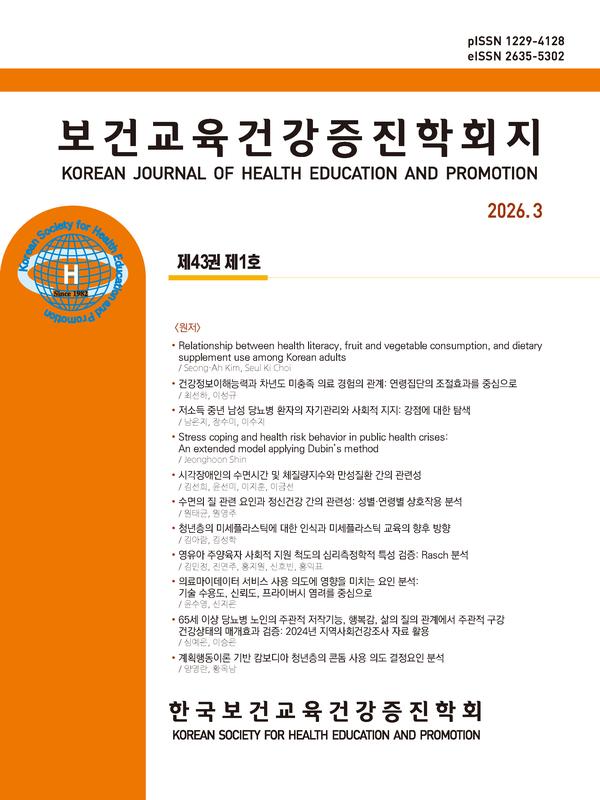
Korean Journal of Health Education and Promotion
Most Read

ⓒ Korean Society For Health Education And Promotion. All right reserved.
Korean Society For Health Education And Promotion
Department of Health Policy and Management, Sangil University
E-mail: bogunhp@hanmail.net